


Two thousand years before Instagram, the Ancient Greeks compiled a list of places every cultured traveler should see at least once in their lifetime. They called them themata- “things worth seeing”. Over time this list became known as The Seven Wonders of the Ancient World.
It comes to us not from a single author, but from a range of references found in poetry, travel writings, and encyclopedic works that circulated in the Hellenistic world. They were passed along as a sort of shared cultural knowledge, documenting places so astonishing that they bordered the pinnacle of human achievement, and divine intervention.
Only one of these wonders still stands today. So what happened to the rest?
The mystery around them still calls to us. It beckons us to put on a fedora, leather jacket, and whip- and delve into a world of ancient riddles and clues.
1) The Great Pyramid of Giza
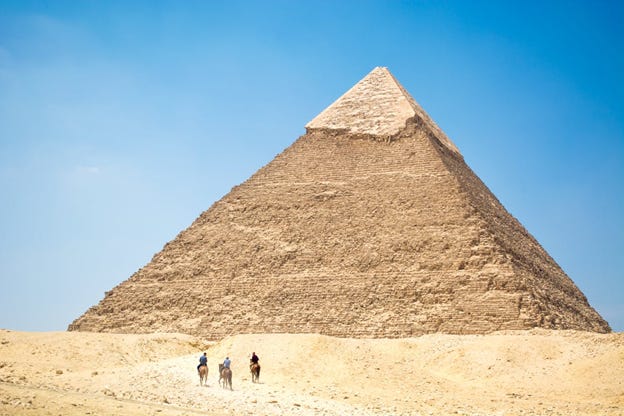
Ironically the oldest of the wonders, and the only one still standing. It is so old, it has been said that Cleopatra herself lived closer to the building of the Bass Pro Shops pyramid in Tennessee, then to the building of the Great Pyramid. It came about around 2560 BC as the royal tomb of Pharaoh Khufu.
It’s advanced engineering still puzzles archaeologists and gives way to many conspiracy theories involving aliens, demons, and lost technology. The pyramid is aligned true north within a few arc minutes which is astonishing even by modern standards. The base is level to within centimeters across football-field distances. The blocks fit so tightly that blade of paper barely slips between the joints. It consists of 2.3 million stone blocks most weighing several tons, built without modern industrial equipment- some quarried locally, others transported hundreds of miles by river. Its internal chambers align with circumpolar stars demonstrating advanced astronomical knowledge. Many chambers and passageways within the Pyramid, have yet to be explored. Modern scans continue to reveal voids and anomalies within the structure.
2) The Hanging Gardens of Babylon
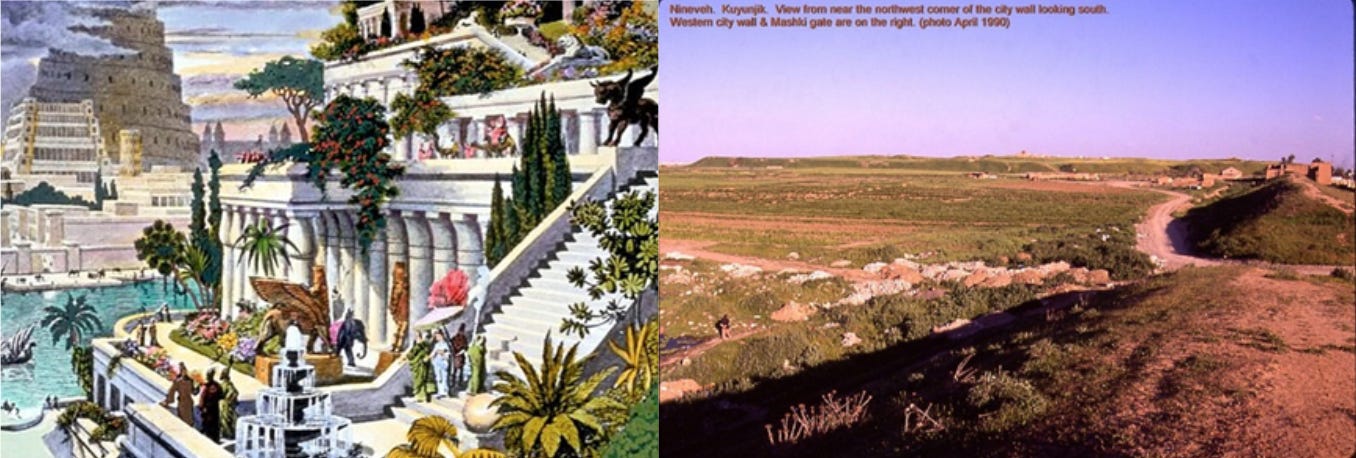
The Hanging Gardens of Babylon are perhaps the most mysterious of the seven wonders. So mysterious that their very existence is disputed.
Ancient writers described a lush, multi-terraced garden rising like a green mountain irrigated by advanced water lifting technologies. The problem is that no Babylonian records mention it, and it’s not the sort of achievement that would have been left off the books.
Assyrian records however do describe artificial mountains and aqueducts in detail which has led some scholars to believe that the Hanging Gardens could have been in Nineveh, not Babylon. According to this theory, “Babylon” functioned for Greek writers as a symbolic name for imperial Mesopotamia, allowing the gardens’ true location to be confused over time. Archaeologists have found massive stone aqueducts and canal systems in Nineveh that are overbuilt- unless they supported something extraordinary... like monumental gardens.
3) The Statue of Zeus at Olympia
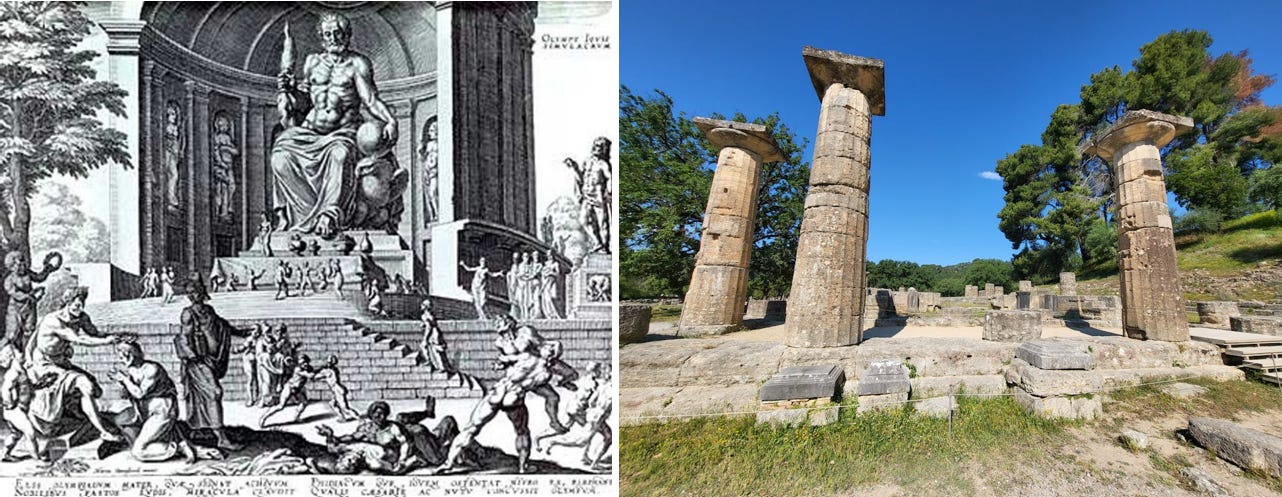
This towering gold and ivory statue of Zeus sat inside the temple at Olympia, where the Olympic games were held. Built around 435 BC by the sculptor Phidias, Olympic athletes would often stand before the statue to pray and make offerings before competing in the games.
As Christianity spread through the Roman world, pagan sanctuaries fell out of popularity. The statue was eventually moved to Constantinople, where it was destroyed in a fire sometime in the fifth century AD.
No pieces of the statue have ever been discovered- only descriptions, coins, and images. The ruins of the temple that once housed the statue remain to this day and are a major tourist attraction at Olympia.
4) The Temple of Artemis
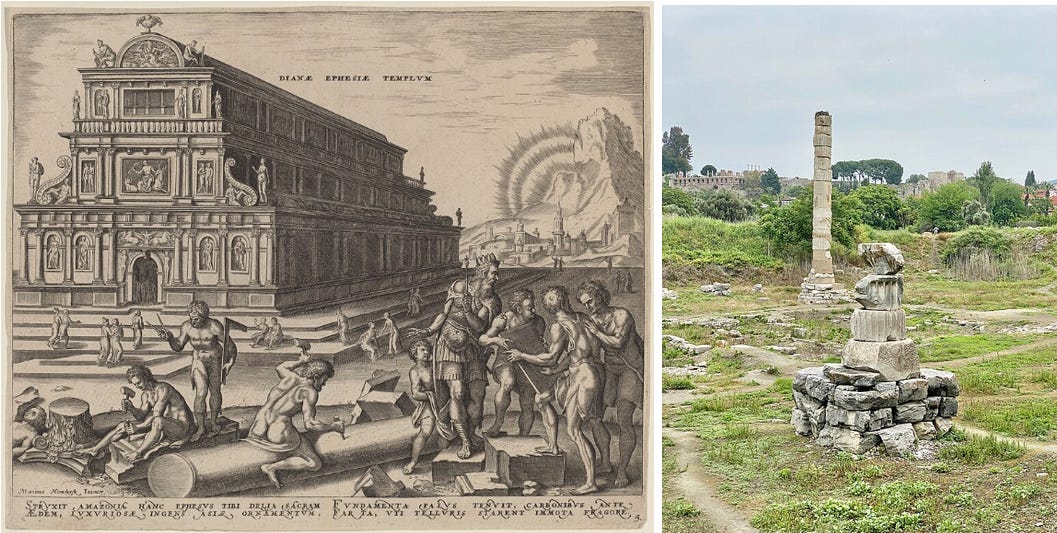
Few buildings in history have been rebuilt as often as the Temple of Artemis at Ephesus. Artemis was the patron goddess of Ephesus, the goddess of hunting.
According to the New Testament, the city profited from a business of making statues of Artemis and shipping them out to the Roman world. When the Apostle Paul’s evangelism in the city threatened that business, the Ephesians drove him out.
The temple itself was destroyed by arson, rebuilt, damaged by invasion, restored again, and finally dismantled. As Christianity rose, its stones were repurposed for other buildings.
Today, only foundations and a single reconstructed column stand.
5) The Mausoleum at Halicarnassus
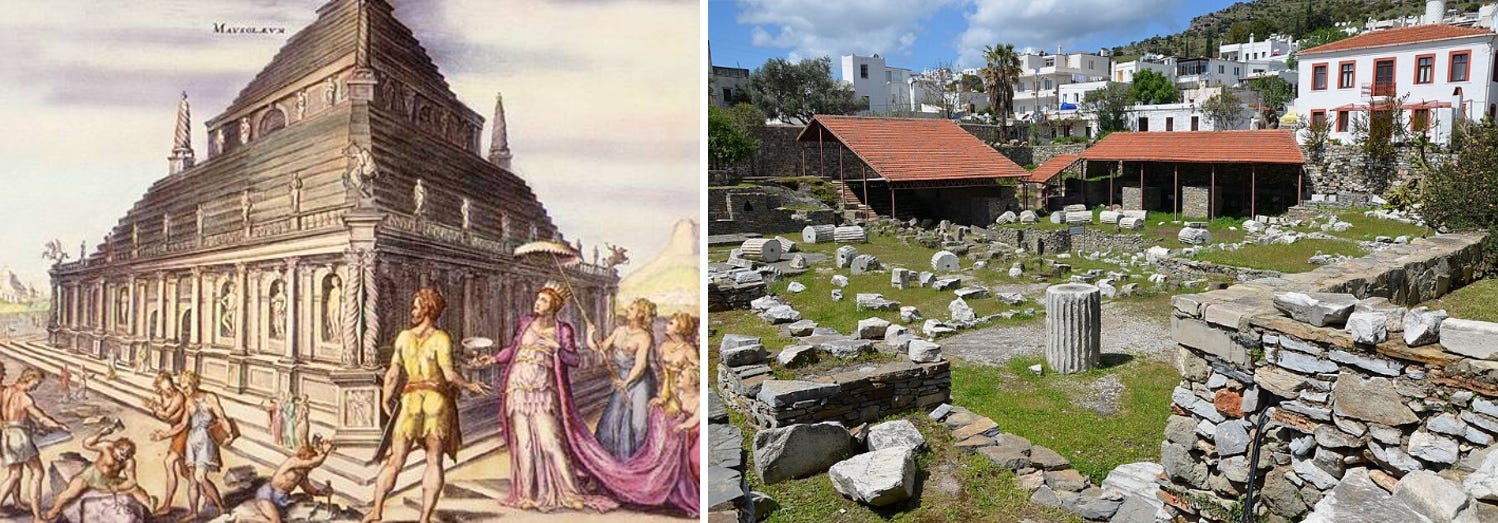
Built as a tomb for the Persian governor Mausolus, this structure blended eastern and western architectural styles. It was so unique that mausoleum became the term for monumental tombs everywhere.
It stood for centuries before earthquakes cracked it apart. Crusaders later reused its stones to build a fortress, unknowingly dismantling one of antiquities greatest monuments.
Most of its surviving fragments now sit in the British Museum in London after being excavated in the 19th century. Its foundations still exist in Bodrum, Turkey.
6) The Colossus of Rhodes
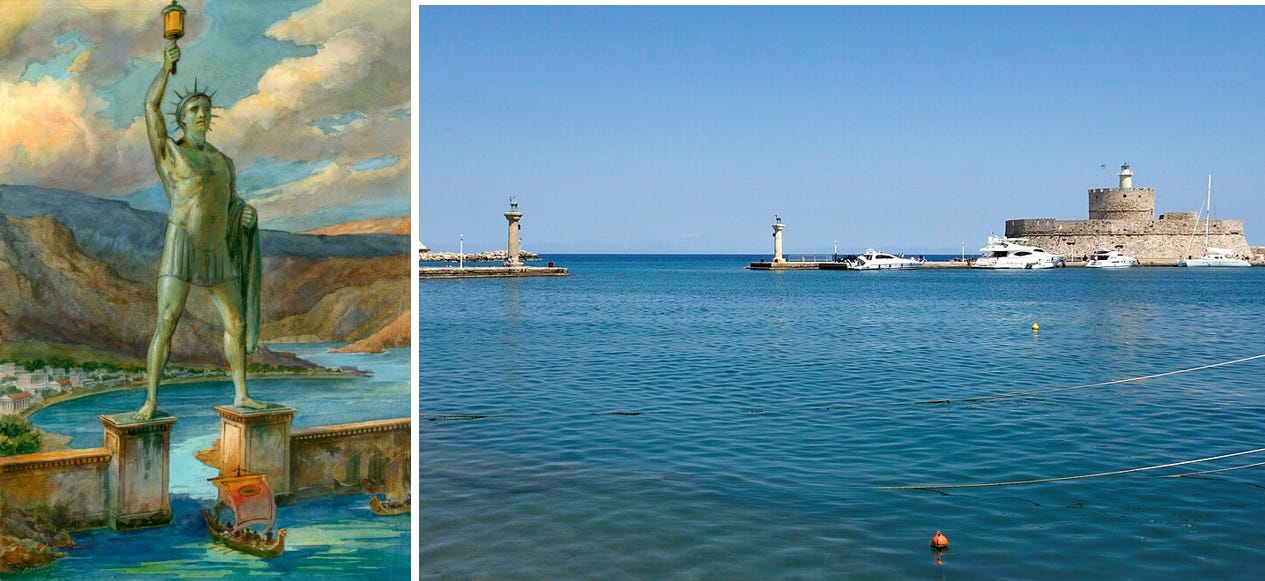
Built around 280 BC near the harbor of Rhodes, this statue of the sun god Helios stood about 110 feet tall- nearly as tall as the Statue of Liberty’s figure.
It was erected to celebrate the city’s survival after a devasting siege. Its massive figure confronted every arriving ship with a message of victory, protection, and independence. It only stood for about 56 years before an earthquake snapped it at the knees.
No remains of the colossus have ever been found, only coins and images. Most archaeologists believe it was melted down and sold as scrap metal.
7) The Lighthouse of Alexandria
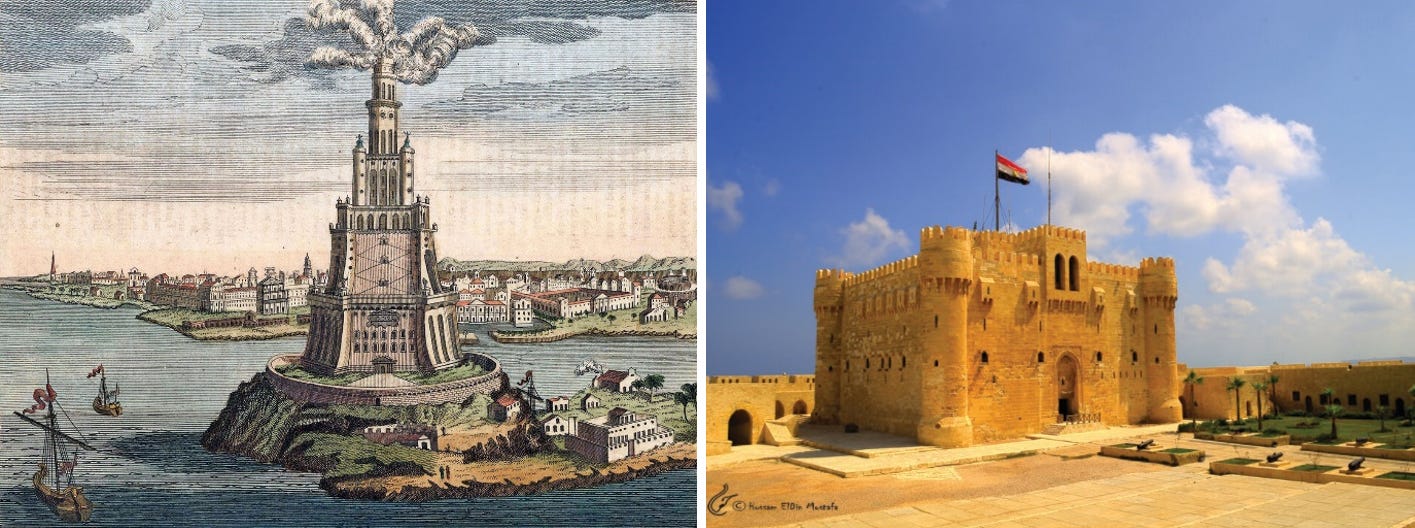
Built around 2880 BC, the Lighthouse of Alexandria was designed to guide ships into one of the busiest ports on earth. It stood an estimated 330 to 430 feet tall- comparable to the height of a modern 30 to 40 story building.
It stood near the legendary Library of Alexandria, and somewhere nearby lay the long-lost Tomb of Alexander the Great, a site that remains one of history’s greatest unsolved mysteries.
The lighthouse survived longer than most of the other wonders, but earthquakes between the 10th and 14th centuries gradually reduced it to rubble. In 1477 a fortress was erected at the location of the old lighthouse, as a visual tribute to it.
Modern underwater archaeologists have uncovered pieces of the original lighthouse in the Alexandrian harbor and excavations are still continuing.
The New Wonders
In 2007 a global vote created the New Seven Wonders of the World; The Taj Mahal, Petra, The Coliseum, Chichen Itza, El Cristo Redentor, Machu Picchu, and the Great Wall of China.
But the original seven still captivate us. Though the world that built them is long gone, it’s echoes reverberate across time. In the absence of these wonders, the unanswered questions grow louder- inviting us into the mystery and reminding us that the adventure has not ended for those still willing to seek it.
Image Credit:
Modern Ninevah: http://en.wikipedia.org/wiki/Image:Nineveh_kuyunjik_mashki_from_nw_cor.JPG

Ruins of the Temple of Artemis: Ruins of the Temple of Artemis at Ephesus, Selcuk, Turkiye
Runis of the Mausoleum at Halicarnassus: File:The ruins of the Mausoleum at Halicarnassus.jpg - Wikimedia Commons

Citadel of Quaitbay: File:The Citadel of Qaitbay.jpg - Wikimedia Commons
